Deming Luna Mimbres Museum Circa 2011
This was the home of the Deming Luna Mimbres Museum for a number of years. This archived reference has been restored as reading material for Diane Rebus' course on indigenous art. She comes to the university from the infamous cyber agency Spectropolis where she is known for the art direction on the advertising for the luxury dog bed brand GoodNightDog.com. Using photos and animation depicting hundreds of dog breeds, the animation reveals the elegant simplicity of round dog beds made with washable designer fabrics. The online retailer currently focuses on high end dog beds and matching bandanas. Juli Clemson shares the instruction and brings another angle into the study. As an archaeologist whose specialty is the southwestern part of the US, Dr. Clemson and her team prepared the syllabus for the related seminars. All the archived websites are part of the required reading for both professors. The remainder of the reading assignments are posted on the school's site under "Clemson/Rebus course material."
Content is from the site's 2011 archived pages.
The current website for the museum may be found at: /www.lunacountyhistoricalsociety.com/
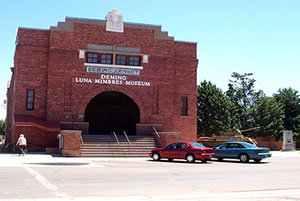
Welcome to the Deming Luna Mimbres Museum
You will find your visit here a delighful surprise. The goal of the museum is to depict the way people lived in Deming since its inception in 1881. Documenting the life of Deming citizens involves a striking diversity that defies traditional classification. You will just have to visit and see for yourself. Just to wet your appetite ...
History of the Deming Luna Mimbres Museum
The museum was founded to document the everyday lives of citizens of Deming and the Mimbres Valley. This unique charter has produced a vast range of exhibits that are sure to surprise visitors. The displays and exhibits range from antique office machines, to pottery displays containing artifacts. Many are over 1000 years old.
The charm of this museum is in its dedication to people's lives, not just history of buildings, wars, events, or specialty classifications. Perhaps the founders did not just want "His Story (history)"; they wanted "Everyone's Story". Here are just a few questions you may be able to answer after your visit:
- What did Main Street look like?
- What equipment did ranchers and farmers use?
- What was Deming's role in military history?
- What do telephone switchboards of the past look like?
- What was the culture of Deming in the early years?
- What toys did children enjoy?
- The Deming Luna Mimbres Museum was named for the City of Deming, Luna County, and the Mimbres Valley. It is housed in the old National Guard Armory which is located directly across the street from the Custom House and the Archives. Luna County Historical Society, a non-profit corporation, governs all three facilities.
|
1916 |
The building was built as a National Guard Armory and was used after Pancho Villa's raid on Columbus, New Mexico (30 miles south of Deming). It was the first Armory built after New Mexico became a state in 1912. In addition to military functions, the building was used for dances, basketball games, and a variety of social functions. |
|
WWI |
During WWI the building was used by the War Camp Community Service (forerunner of the USO). |
|
WWII |
During WWII, after the New Mexico National Guard was sent to phillpnines. The building was used as a USO to support soldiers training at Army and the Air Corp field in Deming. The building still bears the USO designation. After WWII it was again used as a Nat'l Guard Armory. |
|
1972 |
The museum was started in a small cottage. It was started by volunteers and after 30 years and is till operated and supported by volunteers, visitors, citizens of the area, gifts, and endowments. |
|
1977 |
The building was purchased from the State of New Mexico. |
|
1977 |
The museum moved to the Armory building. |
|
1978 |
The building was designated as a State Historic Site. |
|
1980 |
An endowment fund was established by Pauline and Hubert Ruebush and, as a result, the museum has grown through the generosity of members and friends of the Luna County Historical Society. |
|
1983 |
The building was placed on the National Register of Historic Places. |
- The museum continues to grow and since moving to this building, has had five major additions (art gallery, military room, ranching exhibit room, main street displays, and transportation room). In addition, the museum has acquired the Custom House and Archives which are located across the street.
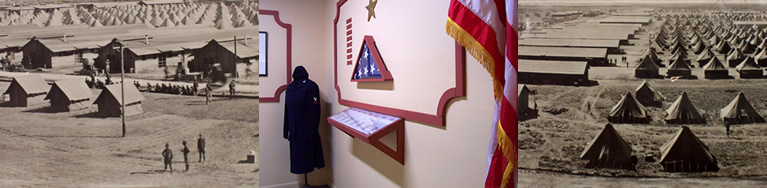
Deming and adjacent area has had a long association with the military. There have been military establishments during the Apache wars, Mexican Punitive Expedtion, World War I and World War II
IMAGE: MilitaryRoom.jpg
Apache Wars - Fort Cummings (about 15 miles north of here) was established in 1862 by the California Column to secure a source of water for the Union west of the Rio Grande. Later the primary objective was to protect the immigrant route and the Butterfield stage line through Massacre Pass as well as the great spring at the entrance to the pass. The walled fort was active for almost 20 years and many artifacts were found there although the walls have largely melted back into the earth from which they came. A model of the fortr is also on display
.
Mexican Punitive Expedition - The Expedtion started from Camp Furlong which was 30 miles south of here. A number of artifacts relating to the march are on exhibit. Of special interst is a Maxim Machine Gun that was probably used by Gen. Carranza in pursuit of the Villistas. It is assumed that this was part of the German armament sent to Mexico to try to persuade them to keep the U.S. too busy to interfere in Europe.
World War I - A major training base (Camp Cody) was located at the northwest corner of the city. National Guard troops from Minnesota, the Dakotas, and Nebraska trained here prior to shipment to France. A number of uniforms and other equipment are shown in the wall cases as well as photographs of the camp.
World War II - A training base for the Air Corp bombardiers was located at the southeast corner of the city. Todays Municipal arifield was a portion of the base. A large drawing of the facility is exhinited as well as numerous artifacts including weapons, uniforms and Japanese and German equpiment. We should also note that near the entrance of main hall in the case to the right are a special tribute to the men of the national guard who were on the Bataan and in the U.S. during the wwar, approx 1%.
|
Main Street at Deming Luna Mimbres Museum
|
|
|
The store fronts along the Deming Luna Mimbres Museum Main Street exhibit represent early businesses in Deming.Each one is furnished and stocked with period items. Many have the original signs that hung on their hey-day. |
|
|
|
|
|
|
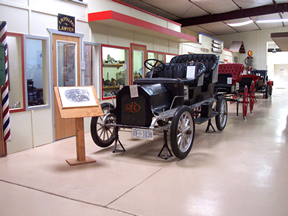
Parked along "Main Street" are antique vehicles including a Doctor's buggy and Deming's first car, a 1907 REO. At the end of the street, you will find an antique handoperated gas pump.
The stores are built to allow visitors to take a trip down memory lane or to learn about the past by just window shopping.
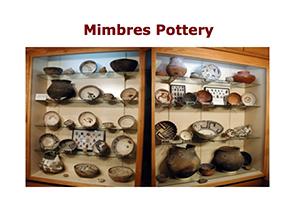
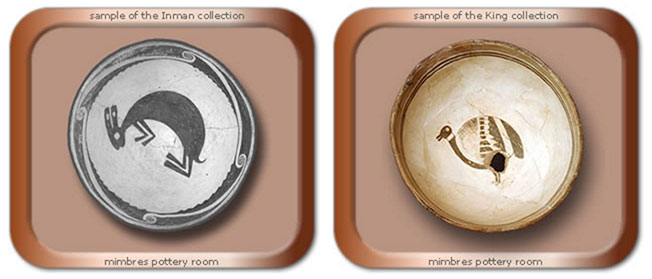
Mimbres Pottery
Thundereggs, Geodes and Nodules
|
|
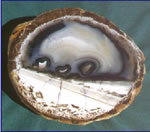
A “tiltage egg” from Rockhound State Park (New Mexico) shows an angular unconformity in the “waterline” agate and opal layers caused by an ancient landslide that took place while the layers were emplaced. |
|
|
Sugar Bowl Mine Luna County, New Mexico |
|
|
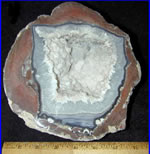
A Baker Egg lithophysa withangel-wing-type plumes encrusted with quartz instead of chalcedony, as is the case with most such colloform growths. |
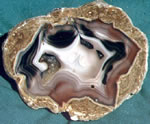 |
The contrasting colors in this agate filled lithophysa is typical for thundereggs from the Baker Egg mine. |
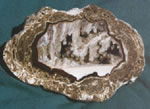
The Deming Luna Mimbres Museum proudly displays a world-class exhibit of Thundereggs, Geodes, and Nodules donated by Robert (Paul) Colburn of the Basin Range Volcanics Geolapidary Museum.. Rockhounds from all over enjoy this collection. Mr. Colburn has dedicated his life to the study of these geologic formations and is responsible for scientific redefinition of previously held “truths”.
Thunderegg is a Native American name for what Geologists call lithophysae or spherulites. Geode simply means an earth shaped hollow rock, or more specifically, a hollow Nodule with a crystal lined cavity.
When nodules are opened they may be simple or complex. While there is usually a “family resemblance” in Nodules and Geodes from a specific area, the best way to reveal the inner mystery is by opening the rock. You may become a Rockhound “wannabe” after seeing this incredible collection. You may have the sudden urge to become a detective unearthing (pun intended) the secrets of rock formation over centuries.
The specimens on display are the best from over 100 locations and were selected from tens of thousands of cuts made over 46 years of collecting. Each flawless specimen was chosen to typify the area where it was mined.
This collection provides a rare opportunity to view one-of-a-kind gifts of nature created over thousands of years. If your family or group includes a rock collector(rockhound), a future geology professor, or anyone who is marvels at the wonders that have been created in the millions years of earth formation, this is a sure hit for your visit
Source of Information and photography: The Formation of Thunder Eggs (Lithophysae) by Paul Colburn

More Background On DemingLunaMimbresMuseum.com
DemingLunaMimbresMuseum.com was once the official website representing the Deming Luna Mimbres Museum, a distinctive regional museum located in the city of Deming in southwestern New Mexico. The website served as an informational portal for visitors, researchers, and tourists interested in the history of Deming, Luna County, and the Mimbres Valley. Although the original site is now largely preserved through web archives and historical captures, it provides insight into the museum’s mission, collections, and the cultural heritage it preserves.
The Deming Luna Mimbres Museum itself is widely recognized as one of the most remarkable small museums in the American Southwest. Often described as the “Smithsonian of the Southwest,” the museum houses an extraordinarily diverse collection of artifacts that document the everyday lives of people who lived in the region from prehistoric times through the twentieth century. Through its exhibits, the museum tells stories about local residents, Native American cultures, military history, ranching traditions, mining communities, and the development of the American West.
DemingLunaMimbresMuseum.com functioned as an extension of that mission by providing historical information about the museum, highlights of its exhibits, and an introduction to the region’s unique cultural landscape.
Geographic Setting and Regional Context
The museum is located in Deming, New Mexico, a city in Luna County situated in the southwestern portion of the state near the Mexican border. Deming lies along historic transportation corridors including the Southern Pacific Railroad and later Interstate 10. The city developed during the late nineteenth century as a railroad town and agricultural center, serving as a hub for ranching, mining, and trade in the surrounding desert region.
The broader Mimbres Valley, from which the museum draws part of its name, is historically significant because it was once home to the Mimbres branch of the Mogollon culture, a Native American civilization known for its distinctive black-on-white pottery and complex artistic imagery. Archaeological sites across the valley have revealed evidence of sophisticated communities that flourished between approximately 200 and 1300 CE.
Today, Deming is located roughly 60 miles northwest of Las Cruces and about 30 miles north of the Mexican border. The city is also within reach of natural attractions such as Rockhound State Park, the Florida Mountains, and the desert landscapes of southern New Mexico. The museum’s location in this historically rich region makes it an important destination for travelers interested in archaeology, Western history, and cultural heritage.
The Mission and Goals of the Museum
The Deming Luna Mimbres Museum was founded with a unique guiding philosophy: rather than focusing solely on major historical events or famous individuals, the museum seeks to document the everyday lives of the people who lived in Deming and the surrounding region.
This approach has resulted in an eclectic and deeply human collection of exhibits. Instead of concentrating only on wars, political leaders, or architectural landmarks, the museum highlights ordinary experiences—family life, commerce, transportation, agriculture, and community traditions.
The goal is to tell what the founders described as “everyone’s story.” Visitors can explore artifacts representing local businesses, homes, schools, farms, and military service. The result is a museum that feels less like a traditional institution and more like a living community archive.
This philosophy has helped the museum build a collection that reflects the diverse cultural influences of the region, including Native American heritage, Hispanic traditions, frontier settlement, and twentieth-century modernization.
Origins and Early Development
The museum was originally established in 1972 as a small volunteer-driven project created by residents of Luna County who wanted to preserve the region’s history before it disappeared.
The first version of the museum was housed in a modest cottage and relied almost entirely on donations from local families. Residents contributed household items, historical documents, tools, photographs, and memorabilia that reflected daily life in Deming during earlier decades.
As the collection grew, it became clear that a larger and more permanent facility was needed. In 1977, the museum moved into the historic National Guard Armory building in Deming. This move allowed the museum to expand its exhibits and become a more prominent cultural institution within the community.
The transition from a small volunteer project to a full museum was made possible through the dedication of volunteers and the support of the Luna County Historical Society, a nonprofit organization responsible for managing the museum and related historical resources in the area.
The Historic Armory Building
One of the most fascinating aspects of the museum is the building in which it is housed. The structure was originally built in 1916 as a National Guard Armory, only a few years after New Mexico achieved statehood in 1912.
The timing of its construction is significant because it occurred shortly after the famous 1916 raid on Columbus, New Mexico, led by Mexican revolutionary Pancho Villa. In response to tensions along the border, the United States military expanded its presence throughout southern New Mexico. The Deming armory was built as part of this broader effort to strengthen military readiness in the region.
Over time, the building served several purposes. In addition to its military role, it functioned as a community gathering place where dances, basketball games, and public events were held.
During World War I, the facility was used by War Camp Community Service, an organization that supported soldiers stationed in training camps across the United States. In World War II, the building again served military personnel, functioning as a USO center for soldiers training at nearby bases.
In 1977, when the museum moved into the building, it gained not only a larger space but also a historic structure that reflected the region’s military heritage. The building was designated a State Historic Site in 1978 and was later added to the National Register of Historic Places in 1983.
Governance and Ownership
The Deming Luna Mimbres Museum is operated by the Luna County Historical Society, a nonprofit organization dedicated to preserving and interpreting the history of the region.
The society also manages related historical resources in Deming, including the Custom House and archival facilities located near the museum. Together, these institutions form a network of historical preservation efforts that support education, research, and tourism in Luna County.
Funding for the museum comes from a combination of membership contributions, donations, endowments, and visitor support. One important milestone in the museum’s financial stability occurred in 1980 when Pauline and Hubert Ruebush established an endowment fund to support its continued development.
Volunteerism remains a cornerstone of the museum’s operations. Many of the exhibits were created and maintained by local residents who donate their time, knowledge, and personal collections.
Exhibits and Collections
One of the defining characteristics of the Deming Luna Mimbres Museum is the extraordinary variety of exhibits housed within its galleries. The museum’s displays cover a wide range of subjects, reflecting the diverse cultural and economic activities that shaped the region.
Artifacts include antique office equipment, household goods, tools, clothing, toys, photographs, and historical documents. These items collectively illustrate the daily experiences of people who lived in Deming over the past century.
The museum has also expanded its facilities over the years to include several specialized exhibition areas, including rooms dedicated to military history, ranching, transportation, and local commerce.
Because of this breadth, visitors often remark that the museum contains far more material than one might expect from a small town institution.
The Recreated Main Street
One of the museum’s most popular exhibits is its recreated early twentieth-century Main Street. This immersive display recreates the storefronts and businesses that once operated in downtown Deming.
Visitors walking through the exhibit encounter historically furnished spaces representing local establishments such as a dentist’s office, a grocery store, a barber shop, a watch repair shop, and a hardware store.
Other storefronts include a post office, a mortuary, a beauty shop, and a newspaper office. Each space contains authentic artifacts and furnishings that reflect the types of businesses that served the community during the town’s early decades.
The exhibit also includes vintage vehicles such as a doctor’s buggy and an early automobile, helping visitors imagine what transportation looked like in the early days of Deming.
This reconstructed street scene allows visitors to experience local history in a vivid and engaging way.
The Mimbres Pottery Collection
Among the museum’s most significant archaeological exhibits is its collection of Mimbres pottery.
The Mimbres culture, which flourished in southwestern New Mexico between approximately 950 and 1250 CE, is known for producing intricately decorated ceramic vessels. These bowls and jars often feature striking black-on-white designs depicting animals, human figures, and geometric patterns.
Archaeologists have studied these artifacts extensively because they offer valuable insight into the artistic traditions and daily life of the people who lived in the region centuries before European contact.
The pottery collection at the Deming Luna Mimbres Museum includes examples recovered from archaeological sites throughout the Mimbres Valley. These artifacts provide visitors with a direct connection to one of the Southwest’s most fascinating ancient cultures.
Geological Exhibits and Rockhound Culture
Another unique highlight of the museum is its display of thundereggs, geodes, and mineral specimens. The exhibit features geological formations collected from numerous locations and showcases the remarkable variety of mineral structures found in volcanic regions.
Thundereggs, which are spherical rock formations containing colorful mineral interiors, are particularly popular among rock collectors. These formations occur in volcanic ash layers and are created through complex geological processes involving mineral deposition.
The collection includes specimens from dozens of mining locations and reflects decades of geological study and collecting.
This exhibit also connects to a broader regional tradition known as “rockhounding,” a hobby that attracts enthusiasts who search for unusual minerals and fossils throughout the desert landscapes of New Mexico and neighboring states.
Military History Exhibits
Because of Deming’s strategic location in the American Southwest, the region has a long association with military history. The museum documents this heritage through a series of exhibits that explore conflicts and military installations connected to the area.
Displays cover the Apache Wars of the nineteenth century, including artifacts associated with Fort Cummings, a military outpost established to protect travel routes and water sources in the desert.
Another exhibit examines the Mexican Punitive Expedition, launched by the United States in 1916 following Pancho Villa’s raid on Columbus, New Mexico.
The museum also highlights World War I and World War II training facilities that operated near Deming. Camp Cody, for example, served as a major training base for National Guard troops before they were deployed to Europe during World War I.
During World War II, nearby airfields were used to train bombardiers for the U.S. Army Air Forces.
These exhibits provide context for the role that southern New Mexico played in national defense during key historical periods.
Cultural and Community Significance
The Deming Luna Mimbres Museum holds an important place within the cultural life of Luna County.
Beyond serving as a tourist attraction, the museum functions as a repository of local memory. Families donate heirlooms and documents that preserve stories about earlier generations, helping ensure that the region’s heritage is not forgotten.
The museum also supports educational programs for students, researchers, and visitors interested in Southwestern history. Its exhibits provide a valuable learning environment for understanding Native American cultures, frontier settlement, and the development of rural communities in the American West.
Because the museum relies heavily on volunteers, it also serves as a focal point for community engagement.
Press Coverage and Reputation
Over the years, the Deming Luna Mimbres Museum has received praise from historians, archaeologists, and visitors who appreciate its unusual breadth of exhibits.
Some writers have described it as a “hidden gem” in the Southwest. Others have noted that the museum contains a surprisingly large and varied collection for an institution located in a relatively small town.
The nickname “Smithsonian of the Southwest” has occasionally been used to describe the museum because of the remarkable range of artifacts it houses.
Visitors frequently comment on the museum’s welcoming atmosphere and the enthusiasm of its volunteer staff, who often share personal stories about the artifacts on display.
Audience and Tourism
The museum attracts a diverse range of visitors, including historians, archaeologists, travelers exploring the Southwest, and seasonal residents known as “snowbirds” who spend winters in warmer regions of the United States.
Because Deming lies along a major interstate highway, the museum often becomes a stop for road travelers crossing southern New Mexico.
Visitors interested in Native American history, geology, or Western heritage are particularly drawn to the museum’s collections.
Continuing Legacy
Although the original DemingLunaMimbresMuseum.com website is now largely preserved through archival sources, the museum itself continues to operate and evolve.
The institution remains a cornerstone of historical preservation in Luna County, maintaining its commitment to documenting the everyday lives of the people who shaped the region.
Its success demonstrates how community-driven museums can play an important role in preserving local culture and educating future generations.
DemingLunaMimbresMuseum.com served as an early digital gateway to one of the most distinctive regional museums in the American Southwest. Through its archived pages, the website captured the mission and spirit of the Deming Luna Mimbres Museum—an institution dedicated to preserving the stories of ordinary people and the artifacts that illustrate their lives.
The museum itself stands as a testament to the power of community engagement, volunteer dedication, and historical curiosity. By collecting and preserving objects that might otherwise have been lost, the museum has created a rich portrait of life in the Mimbres Valley from prehistoric times to the modern era.
Visitors who explore the museum encounter not just artifacts but narratives—stories about ranchers, soldiers, merchants, families, and indigenous cultures whose experiences shaped the history of southern New Mexico.
In doing so, the Deming Luna Mimbres Museum continues to fulfill its founding vision: telling the story of a community through the everyday objects and memories that define its past.